Thursday, May 2, 2019

Taking the plunge: a 'new' "short VIX" Market

I finally did it, took the plunge and signed up on PredictIt
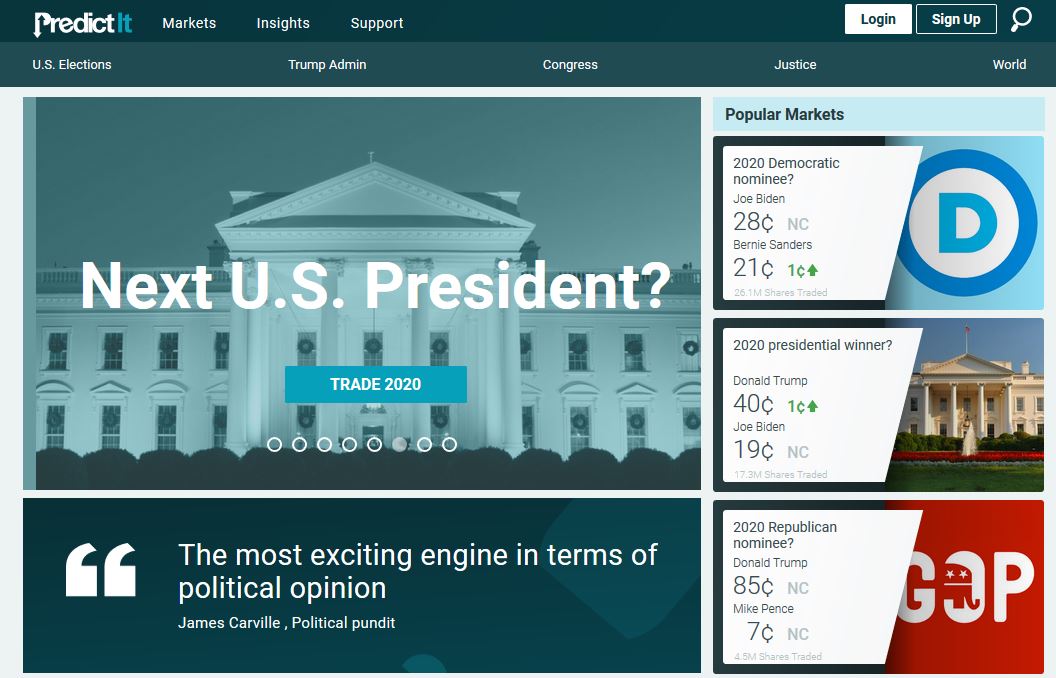
I've been wrestling with this for a while because of my two main conflicting forces : expected value vs the macro dream of short VIX, prediction markets, a much more liquid/expanded future of markets.
On the EV front nothing has improved, PredictIt still has a 5%  rake on wins based on your cost basis and a 5% rake on withdrawal, making it an effective Hotel California, but ultimately it is the only way to get exposure to non equity 'short VIX' markets which I've been blogging about for 2 years: the conceptual 'real life' volatility of events and fading unexpected outcomes.

Delving in: How is trading politics a short VIX trade?

 I actually don't see this as a partisan/political trade at all, rather getting exposure to the mechanics of government regardless who is in the House/Senate/executive. (and possibly international election markets as well, but I think those are more correctly priced)

Lets take one of the most traded (on volume) bets on the board:


As of posting this the line is at 21c yes/ 79c no (forgive the screenshot timing mismatch) meaning being long the "no" at an avg. price of 79c would be worth $1 at "expiration" on Dec 31 2019,  a (21/79)~ 26.5% ROI (before the death rake) in ~7 months, which is ~42% annualized. 

Already I've inserted the phrase "expiration" so I've somewhat played my hand, but if you don't see where I'm going with this:
We are looking at essentially a short premium/ theta decay trade where there is a 21c option premium burning from now until Dec 31. (logically with 1 month or 1 day til expiration, the trade should be at 99c no/ 1c yes, as you can see several other 1 DTE political/election trades appear on the site)

The crux of the issue however: Why is this an obvious no? (a winning long 'yes' at 21c is 927% AROC) 

Well, #1 if you care about option markets/sports betting, the overall direction is that it is a no given the spot price- the issue is how correctly priced it is, how much theta we are looking at ,etc.
(#1.1- why is this different from Trump having 1% chance to win the night before the election? - those were polls, not prediction markets/ skin in the game)

#2 lets look at the historical trends of 2/45 POTUS getting impeached, if you are in the 'spherical vacuum' of picking colored marbles out of a bag, that is a 4% which is closer to what I would assume this market should be priced at.

#3 the real meat of the assumption- the layers of government/bureaucracy/politicization we are looking at that create a 'status quo' buffer.  Politics broadly is about little victories and compromises, meaning set the goal post of impeachment, then shift that to 
-better mid term election numbers
-more twitter followers
-more campaign contributions
Which become a somewhat measurable 'smaller victory' and shift away from the red tape nightmare and optics of losing a majority vote on impeachment.
#3.1 the counterplay of IG Horowitz/FISA 'legal action' etc coming the other way, politically it might make sense to have an effective truce effectively adding to that status quo buffer.

A few more points on this trade specifically:
 Which has spot 'no' at 72c for a Jan 20 , 2021 expiration (21% AROC- literally half the 2019 trade for an almost identical market direction/assumption)

-Compare to 'trump GOP candidate', 'trump 2020 winner', which have him at 2x the next place. If that is where the line on those markets are, then a >20% chance of impeachment vote seems fundamentally mispriced as a reflection of the incentives of the house and senate to conform to their constituent status quo.

-Compare to world election markets currently up: Netanyahu indicted, Nigerian pres re election, pope vacancy- All with lines in the <10c range which seem much more correctly priced given that you are trading a massive upset. Compare that to the .90 delta equity options when get hit all the time!

Now looking toward other/broader PredictIt trades
The trump 12/31 impeachment is just one example with some pretty clear numbers, but is by no means the end of the short VIX/ theta decay I'm looking at.
Some others that come to mind:

Both have a very similar short VIX structure to the Trump impeachment trade, despite them being polar opposites politically- which is why I prefaced these trades as non political.  We are looking at fading a historically unlikely and status quo buffered move, with a defined duration / AROC.  The Trump version of it is just a little more juiced, but I'll probably add on positions in all of them.

Lets look at some cons:

 So we have gone over this as a semi uncorrelated market to equities with some actual ROI numbers, fairly tight markets (better than many equity options) and most importantly a small enough total market to not get insta zapped by big bank algos(thus the mispricing) but obviously it took me a while to bite the bullet because of some big problems:

-Insane, unbeatable rake: 5% on profits and 5% on withdrawal. That is some live poker, 2/20 fund manager level of unbeatable, so you basically need trades like the trump 42% AROC to even think twice.
-Inconsistent markets- as we are entering election season we have a lot of new trades coming up, and specifically under trump with the nonstop legal backdrop on the whole presidency, we probably won't have this kind of impeachment risk premium going forward.  This ties into the "AROC" issue, as these 'impeachment/ by end of term' trades are 1 time, and thus bad for an AROC model like compounding dividends or rolling option premium monthly.  Unfortunately we need some way to quantify things, so we have a trade, risk ,and duration, so there you are.
-Counterparty risk- here is a big one, PredictIt is pretty much the only one in this space, with a few sports betting sites touching US election/primaries, but nothing with the depth of the justice department investigations, world politics.  We are already looking at withdrawal 30 day type issues and who knows what kind of regulatory/ liquidity issues could spawn.
-Size - lets call this .5 because due to the above counterparty risk, you should probably stay small anyway, but there is a total position size cap, which is good in some cases as it keeps big fish out and keeps potential mispricing.
-All or non trade- Yes this is basically just sports betting, where you win or lose all at expiration, you can't sell a call against your position/ flatten your deltas, / lower your cost basis, so ultimately I think of it like a vertical spread where at entry you are looking at a max premium win or max loss, take it, and move on to the next trade. This ties into sizing above, as sizing/ risk management is half of vertical spread/ leverage trading.


Lets start here for now, I've got a lot more to add in terms of discussing the current trades, upcoming trades as they are added to the site , as well as such prediction markets being a big part of my future vision of markets.

Stay tuned!

Friday, April 5, 2019

The QUIET New Deal

"Wherever I am, there is also... a leafblower"

I have a proposal for all Green New Deal liberals - without even immediately discounting the 'no planes' / full remove fossil fuels , $100T annual global policy change.  As a self identified 'conservative' MMTer , I can't go to the well of 'that spending isn't feasible, how will you pay for it!' etc

I just have one preface and THEN we can go there.


NO LEAFBLOWERS.

If you are a liberal/green new deal politician or supporter, I want ALL LEAFBLOWERS gone from your district before you even start going off on how will manage changing the fossil fuel global economy. Some even have gas in them, so it should be step 1 on your crusade anyway.  What is greener than having leaves everywhere and no deafening power consumption 24/7?

As someone living in the liberal ground zero epicenter Fukushima/Chernobyl Los Angeles, the Green New Deal probably has the most support here and yet we still have 12hrs of leafblowers per block everyday.

This is my #QUIETNEWDEAL

If you are debating with a green new deal liberal and they won't interact on the budget/fiscal policy/incentives etc axis, simply shift the Overton Window to "I agree with you, why can't we solve this tiny subsection of your problem 1st, to prove you are right?" I'm trying to help you out!

I'm waiting for the day we can finally meet a liberal legislator/ governor and say "wow, you've gotten leafblowers and noise pollution out of your district, dealt with the fiscal and social policy/ incentive scope of that. Great, now you can present the full logic for your global green new deal"


As usual I expect zero rebuttals or even responses.
Also VIX down of course.

Wednesday, March 13, 2019

The 2018 short VIX Odyssey

As usual I try to avoid "trade journaling" but this felt like a broader 'proof of concept' from the last few months-


      If you can remember back to the far left here, just before the 2018 3 month sell off AKA the "December Glitch" I was selling call spreads at the 40 short strike with ~6month duration. 
As if in a cartoon, UVXY almost instantly 2-3x'd against me, thus began my 10 year Trojan war...


Since September, I added on more to the short position and sold puts/ put spreads against it to flatten deltas, some getting back off for a scratch, some a small loss (note the huge drops back in 2019)

Ultimately that brings us back to this week, almost exactly at expiration with UVXY returning home to Penelope at 39.xx ...

Since I'm not a pure fentanyl rush gambler, I've been slowly taking off some of the short call lots for a scratch or small loss as we approach expiration , while flattening deltas with short puts, basically reducing crash/spike risk as we almost return home. (Its more thematic to fight the cyclops in the middle of the journey than to get bludgeoned right back at your doorstep)

So basically we have a 6 month scratch trade, this isn't what you point back at to clarify genius... this isn't going 100x leverage on your student loans to buy penny stocks/crypto and 20x, so who cares?

The point is the inevitability of the short VIX complex mechanically, and even a very bad trade can be managed/ flattened, but ultimately saved with duration at the beginning. 

Takeaways/ Going forward- 1yr duration
In hindsight I was happy I stayed more conservative with the 6mo trade into those Oct/Dec spikes, while some of the short vol crowd were putting on the 'traditional' ~45 day premium trade.  I did a lot of backtesting in the last year before the UVXY leverage rebalance, and was looking at the 6mo to 1yr duration, and especially now with the deleverage I would lean to the longer duration to offset the weaker decay.

I'll wait for another vol pop to re add long duration positions (we've been vol crushing for a week now), but to eyeball a trade with UVXY spot at ~40, the 1yr 40/45 call spread looks about 33% ROIC, which should be very good for a conservative annual trade.


Wednesday, November 28, 2018

Short VIX bulletpoints for November

So much happening and I'm mired in the vortex, the morass at work with barely time to create my usual C-/D+ quality content ie:
Anyway, rather than super ramble here are some short VIX bulletpoints:

China rules out UST selling in trade war
- was probably a non factor anyway but just another glimpse at the back end where the USD hegemony really cant come down from normal conditions and China, etc know it-

Pelosi renewed as speaker
- "the definition of insanity...etc etc" anything that is gridlock-ish or 'status quo' lends to the short VIX macro idea that as long as government is pretty split and sprinting toward the middle/moderate
(thought its hard to label her moderate left), then we have an environment where there is less political tail risk. (Despite Trump appearing to be the tail risk boogeyman, he has been pretty moderate, especially in his reversal on fed policy)


Powell's speech
Possibly the fed "blinking," although along with 10yr coming back from the 3.2% peak to ~3%, this
speech and current normalization set the course for a gradual decline.  Again, in my sense "bullish" is just avoiding meltdown, a flat/choppy sideways market is 'bullish' for a short premium/ covered call, OTM short VIX plan.

Wednesday, September 19, 2018

Dissecting the Janet 'Lower for Longer' post

Two main bulletpoints from this last week or so:

I only saw the "lower for longer" quote in the context of allowing longer bull runs to "make up" for bear markets, etc. which was laughed at all over finance twitter.  I finally got around to reading the full post which had a lot more horrific meat to it than the 'lower for longer quote' had on the surface.  Again this all falls into the short VIX macro thesis from previous posts on the unstoppable force of central banks, etc.

The horror starts in this section:

The FOMC should consider a number of approaches
  •  Longer term asset purchases
  • Interventions to directly target longer-term yields (Similar to BOJ's yield curve control approach)
  • Negative nominal interest rates
  • Raising inflation target
  • Adopting price or nominal GDP targeting 
  • "I have argued that asset purchases worked and should remain in the Fed's toolkit"
To be fair she semi walks this back in "seeing considerable disadvantages with each of them" but why even mention the FOMC 'considering' these things?  It reminds me of the Annie Hall joke:

"Right now it's just a notion, but I think I can get the money to make it a concept, and later turn it into an idea"

This whole post comes back to the macro short VIX / long equities concept that Janet posts like this are the bullish case.  Bulls and bears can agree that the Fed doesn't know what they're doing and econ concepts don't apply to the Amazon era, and they're probably right, but that doesn't change the mechanical fact of markets being augmented by policies/ideas like this- a theoretical buyer of last resort, a force whose only job is to stabilize USD with more theoretical resources than every other trader/algo/fund combined because they set monetary policy, they control the parameters of the game.  Everyone else is just a player in the game.  Yes the whole thing can blow up like every past civilization but in that corner case the opposite trade will have no payout either, the game ends and all your internal game expertise ends with it.  


Tying into this was the "Water in Markets" post above, which articulates part of this bear case being the liquidity crisis that will destroy the market, and yes I agree there is a definite liquidity crisis- I don't even think that is arguable given the price, volume, and spreads in February.  That being said they have to contend with such statements about liquidity sources of last resort which happened in 2008, and what they want their "crash" to look like.  What ceiling do they want on SPX? IE if their option position is looking for a 50% decline for their 100x return, what if they get more than they wished for, if the liquidity crisis fully blows up the USD and their 100x payout is worth nothing?  So if you want a 'constrained' crash just for P/E and every 'value' metric to go back to a unanimous 'buy' range, just for SPX to go back up, then how is that different from just being long SPX now, like the passive funds they are worried about. 
The water metaphor goes to yell at the liquidity-oblivious passive funds (and they are), without pointing out the point that their 'target crash' dream is its own 'water' and they don't want to splash too far out of that where the USD ends.  They don't really want to reconcile true 'end state' behavior in a math/limit/series sense.   
That being said the "water in markets" and the original DFW speech are both fairly high level and appreciated, but even then they don't go on to address the hole in their argument, which is kind of unavoidable. Once you use the "reality as water" metaphor/argument, then you also kind of have to reconcile the theoretical "water" of your worldview, which is in this case a bigger crash/repricing, but not TOO big! Then that would be a bigger pond to splash out of.

Any rebuttals from anyone? Assuming I'll just lose another few followers...

Wednesday, September 5, 2018

The TWTR hearing and FANG resilience

I should have made more notes during the $FB hearing, beside general shock, but now watching the $TWTR show I have to go off a little because its so entwined with the macro thesis.


A blueprint for senate hearings:
Senator: I'm going to be very tough on you, here is a softball question with no technical specifics in it.
CEO: First of all thank you all so much for inviting me. We have a lot of work to do together and we know we can do better.
Senator: What was the result of (some glaring free speech, antitrust, insane revenue, privacy/data issue), can you explain what happened there?
CEO: Thank you so much for your question.  I don't have all the specifics of that right now but I'll will get back to my team so we can get that to you.
Chair: The gentleman's time has expired. Thank you again for coming to speak with us. Can I get a selfie with you after lunch?

You can probably go back in the last few years to the Wells Fargo, joint airline, FB, and TWTR hearings, and I'm forgetting several others that were all like this.  Maybe 1 senator pretended to act tough, but usually with a completely unrelated question.  Additionally you have the half of the room who are giving gushing support and have even further unrelated questions/comments.

The real point of this is that there is no aftermath.  Every company can go back to business as usual, which is what short VIX is- business as usual is flat or decreasing risk premium.  More importantly, the longer there is no aftermath, and this precedent is more and more established, then it makes it easier for CEOs to follow the above script and wait for the issue to blow over, til the next school shooting grabs the Senate's attention like a cat with 2 different laser pointers.

Going more specifically to TWTR today and FB recently, it was clear that the Senate and congress have literally no idea what is going on with the scope of how FANG runs the country and planet.  Senators were asking if they were embedding notifications that a closed account was Russian, while meanwhile every big data/social media analysis is showing the addictive design of these services, which is arguably rewiring how kids(the next generation) think.
For "freedom of speech/hate speech" issues they go directly to "what are you doing to block X" without any mention of even understanding the point of freedom of speech.
Some notes from today's TWTR hearing:
  • I was almost sure that a month or so ago Twitter was denying any kind of shadow ban/ throttling users, and today Dorsey was proudly saying how they greatly hide/throttle content/users they don't like.
  • Senator Harris vs Sandberg asking about a specific .004% revenue figure for the ads linked to russian posts, almost presses her on saying how they have no metrics/no idea on how to list this despite having a number to 3 decimal places, then just drops it. (the above script of "thank you our time has expired") 
  • Senator King vs Sandberg asking about user rating/credibility rating attached to accounts, probably missing the fact that they will be crying against China's version of a social credit score in some upcoming hearing.  This tied in with Dorsey questioning the importance of likes/followers as the primary incentive metric.  This was a really telling point as the people with the data internally are trying to show how warping these incentives actually are, yet it was lost on every senator who just went down their index cards.
Getting at more the financial structure/backdrop of these companies, again it seems like the Senate is not even mentally equipped to get at the scope of how vertically integrated and dominant Amazon et al. are.  I would love a poll of congress and senate to see how many of them are even aware of what Amazon Web Services is and the the scope of hosting.  The more the Senate hearings are mired in 'what is free speech' and smaller concepts that they still can't wrap their head around, the longer the underlying vertical structures can grow unfettered, so by they time they have the Amazon hearing, you will probably have all of the government's data on AWS.

Comically, the closest 'discussion' to the Amazon scope is from liberals who are only discussing the tangential issue of worker wages/subsidies
and are missing the point that little band aid type bills don't address the core issue that if Amazon is that big, and government has to come to them for data, it is basically entwined with government in a way on top of the normal lobbyist structure.  I've posted before that separation of corporation and state is this century's "church and state", and from hearings like this its clear that lawmakers arn't even aware of the corp/gov overlap.

So what does this have to do with short VIX?
I think every one of these incompetent hearings is bullish for FANG and thus short VIX. (note here in the short premium sense, "bullish" is just that it will hold up or be within a st dev on the downside so that selling puts or vix call spreads is the best strat. I'm not looking to reach for 10x trades)
The end state of capitalism is one company, so hearings like this that don't speed bump that set the seeds for the continuing snowball/network effect into these services and thus global  investment into these companies.

Any questions?


Monday, June 11, 2018

Visualizing the end of USD

With FOMC, North Korea meeting, G7 trade issues buzzing on the hashtags, I wanted to present a thought experiment:
What would be the actual path/logistics/mechanics of USD ending as the reserve currency?
You may have seen this type of chart here and there (most commonly with Bitcoin being the next bar surpassing USD), with the assumption that Russia or China would be the next bar? If not, who?

In the same way that the end state of capitalism is a single company which absorbs any theoretical competition, there is a kind of macro capitalism where a country/economic system (namely the most liquid/deepest/free-est) has the potential to absorb other systems just based on that liquidity.  A way bigger picture way to think of this is the end state of capitalism anywhere being a single company everywhere, in the sense that private industries/ government entwine to where the line is blurred or indistinguishable.

The first theoretical path is war, external challenge, etc.  I just don't see how true nation vs nation war can exist anymore.  The level of mutually assured destruction/ mutual deterrence must almost cap at some point, and now the entire focus is on diplomatic paths to reducing nukes (except for the US, a coincidence?)  Additionally, with the amount of nukes/ drone strikes, cyber attacks, we have entered the full Pyrrhic victory zone where any war would end the future concept of currency or 'economy'.  In practical terms as we are looking for an investment thesis, no alternative investment would matter anyway in this scenario so its almost something to disregard when comparing ROI on different country exposures, etc.

The next path to consider is the type of internal degeneration that would lead to some currency crisis.  While I agree on every indicator that all assets are garbage, subprime auto loans, etc going back through the roof, household debt, I think the doom and gloom articles disregard how bad the alternatives are.
I think back to the Network scene of "no countries, only corporations," and it is more true everyday how entwined the global economy is.  The current "trade/tariff war" will just cyclically lead back to opening up trade again, probably spurring equities to all time highs.  In this way I really don't think "internal collapse" can be represented in the same way that has come up before with the collapse of past civilizations.  As US "debt" is held by most of the world, and an equal web of debt swaps going the other way, there is a similar mutually assured destruction in the credit sense as the above missile example.  All this means that an "internal collapse" really can't happen in isolation, there is no true "internal" anymore.  The global financial system is "too big to fail," with USD sitting at the top.

Additionally, lets think prophylactic-ally, what is the point of having the most military spending and biggest military stationed the heaviest around the world, if only to let it all go if the USD is challenged?  If such a deployment keeps the USD/ petrodollar supremacy, then it almost transcends the notional price required for it.  Its like a meaningless purchase inside a game going outside its own scope, in a monopoly game "hey I'll give you $100 Monopoly bucks for the game itself."

Anyway, given just these points, how can we even visualize China/Russia taking the reins?
-It would start with an end to the petrodollar, which
  • Will be defended to the end by the above military
  • Can potentially be replaced by the next mandatory resource (electricity? other element?) with a similar USD agreement
-It would require either system to fully reinvent to allow more liquidity and market depth than US markets, which they haven't even tried (Chinese daily govt intervention in markets, Oligarchic business control in Russia)
If we have learned anything from the crypto show, its that liquidity is the true metric of usage, seeing actual usage shift from BTC to Monero as a response to a need for function was eye opening when compared to the initial thesis of the value proposition of the longest chain.  Even security takes a back seat to liquidity in this sense.


There is probably another hour to go on this (the end of revolutions, no single castle to attack, 100% cashless economy) but the quick takeaway is that the combination of a global digital economy and the technological level of warfare seem to prevent the end of USD, because USD is really across borders, and reflective of the entire global monetary system.