Showing posts with label verticals. Show all posts

Wednesday, January 31, 2018

Thin value pt 2- soft cap iron condor

Continuing from my last post on the "thin value bet" to add a little juice to short VIX positions, I thought I'd add a sample trade/ more fleshed out idea-

The soft cap iron condor:
My idea for this is basically a very skewed iron condor in certain conditions which aims to add a little premium or reduce max loss on a position at the chance of losing due to a huge vol collapse.
Taking the existing portfolio risk of 10-20% max draw down with your short vol positions, we add verticals on the other side at about the 20% monthly decay mark which is about the max where VXX goes per month- the "soft cap".  Those verticals aim to have a max loss equal to the max profit of the short vol verticals, meaning there is no risk of loss to the short vol side, but you theoretically could have a month ending up a scratch.  In real trading conditions that much vol decay would have you rolling up/down the other side, but that complicates the simplified model.


I was going to scribble this out in MSPaint but what is thinkorswim even for? Might as well make it look a little more accurate if we can. So here is the "soft cap iron condor" in VXX :
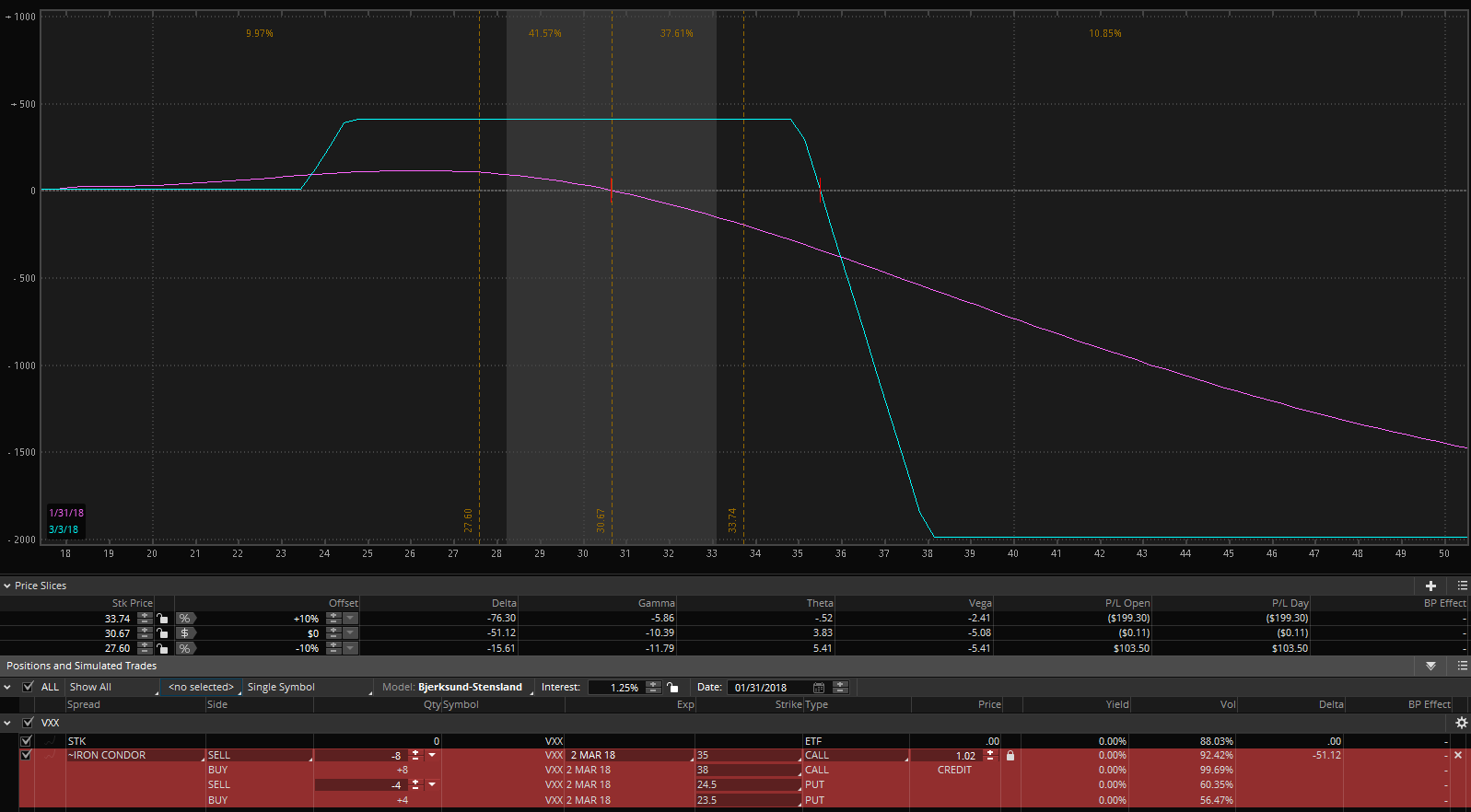
 This is using sample numbers from the 1/30/2018 close, with VXX at 30.60
Assuming a sample 10k portfolio, targeting 20% max draw down from the short vol positions (verticals) we would have 2k max risk to play with-
Short side:
35/38 call spread (~15% out of the money) for .44 cr, $256 risk =~ 8 spreads
= $2048 risk, $352 credit

Normally this is where we would stop, but depending on spot VIX being super low, low spot with not much /VX premium over spot, or if your positions are at max loss and you want to take some max loss off, we add the skewed opposite side:

Long side:
$352 risk available, from the $352 credit from the short side
20% otm =~24.5 put
24.5/23.5= .13cr, 87 risk =~4 spreads
$348 risk, $52credit

Why is this different from $SPY iron condors?
Unlike straight stocks that have earnings, buyouts, crazy FOMO, short squeeze/melt ups, VIX products have some conceptual constraints which I was pointing to earlier such as the decay behavior in the 9 handle:
Going back to SVXY/VXX inception, 9 handle VIX closes don't hit that 20% monthly decay historically.  Again this might not persist forever but its at least a start into quantifying directional risk differently for this different product.  

Conditions/issues:
-Obviously there is no free money anywhere so this is just a way to flatten risk and add more trade offs.
-I wouldn't do this right after a VIX spike because historically that is when you can hit those 20% monthly decay numbers (the quick VIX drop after a spike). I might add this on if after a VIX spike if all my other positions are max loss and you would be fine with a potential scratch for the month if it would take some max loss off.
-Obviously we won't be in the 9 handle forever so as spot VIX gets higher the 20% monthly breach risk goes up.
-It seems like the lower liquidity products (SVXY) almost factor this in and a lot of times the ~20% otm strike on the long vol credit side is the last one, meaning you can't make a vertical to reduce buying power reduction. For example even though most of my positions were SVXY short put spreads, a single 20% otm naked call was 20k BPR in Tastyworks.
-Due to the spread/liquidity issue, this type of trade might be confined to VXX.  However, when dealing with such ~.12cr spread, depending on your broker the commissions really eat at those if you don't have some bulk pricing, so again this is really a marginal trade I wouldn't have always by default.

All of that being said, this might be a strategy to consider more as we go into a higher treasury yield/lower dollar environment where VIX might reach a new normal above the 10-11 handle that we saw for most of 2017.  If we have more choppy market action then having a trade like this on might allow for single day VIX spike windows to take it off at a profit and look to re establish in a few days.


Thursday, January 25, 2018

Thin value bets- flattening VIX delta

 Another poker metaphor, the thin value bet:  you might have top pair/ two pair on a potential straight or flush board, get checked to on the river and make a small 'value' bet in position.  If the opponent has nothing, they probably fold and you get no value, they could also be trapping with a big hand and giving you the rope to hang yourself with.  They could even call with a better 'hand that can't call' like a pair with better kicker.  The key case and point of this VIX trade is when they call with a slightly worse hand, and pay you off with the 'thin value.'

I think it was Phil Galfond who said 'if your thin value bets never get called, then you aren't thin value betting enough.'  This is where I'm starting from in this trade idea: yes we are adding some risk, but over thousands of hands (or trades), we are trying to boost expected value/yield/pot odds/whatever metaphor you're on.

This goes back to a post I made recently with VIX still in the 9s, I was examining the max monthly SVXY up moves for the product's history, looking to kind of bet on the decay 'cap' given the mechanics of /VX rolling to spot:
My finding was that with spot VIX under 10, SVXY never had a monthly gain topping 15%, which is coincidentally right around where the option chain ends on a lot of cycles.  (Almost like they are trying to tell us something).  That being said, the last strike is usually at the 15% mark, but with no strike after that, you can't create a spread to reduce buying power reduction, and for SVXY nosebleeds the liquidity/spreads are horrible so you would have to probably hold til expiration and take the hit either way.  (And obviously this 9 handle soft cap trend might not continue going forward)
On the BPR point, I was again looking at SVXY calls today and even though I have a couple hundred long deltas, it looked like there was no BPR offset (on Tastyworks at least), so a 150 short call was like 20k bpr.  (this was around the 15% mark if you are reading this in the distant future).

In the search for yield I went back into the more liquid VXX to look at the numbers with us now in the 11 handle:
Obviously there are more 15% breaches when you go from 9 to the 11 handle, but when looking further at the roll yield/roll premium/contango (/VX to spot, whatever you want to call it) for some of these days, the front month difference was more pronounced than now with usually over $1-1.50 between spot and /VX for ~30 days.
Here is one such day from the above spreadsheet where 1 month from this date VXX lost ~20%

Given the current term structure, the roll yield has been around $1 or less for the average 30 days, so that lowers the mechanical chance of an insane 15% breaching run.


Given all this I bit the bullet on VXX Feb 23 23.5/22.5 short put spreads for .12c credit, this being my thin value bet. (on 1/25/18)  Given the data its a marginal ish trade (right on the 15% decay edge and the %ROI takes a hit due to commissions at the low total premium levels unless you have some insane volume with a specific broker), but is effectively flattening my total short VIX delta at a credit.  If I have all this short VIX delta, I'm at least tickled to try to squeeze a few more drops out.

Historically I've been more scared of the VIX downside than upside (or reverse for SVXY) because with spikes it will come back but if you are long VIX it might never come back, and the only adjustment when it aggressively grinds against you is to move up your short VIX strikes and add more risk for incoming spikes.  All that being said- if this is breached,
1. it is statistically unusual, and
2. the majority of the short VIX portfolio is going to be hitting max profit way sooner and compounding as I keep rolling up and out.

Again, this is a complement to the short VIX portfolio, I am still negative delta on VIX, and the max loss to the VIX downside is only ~1/15 of my VIX spike risk.  I'm just dipping the toe in the water, so this is possibly something to leg further into.
Additionally, if you care about macro factors such as the lower dollar index and increasing bond yields and think the heavy decay of 2017 with VIX in the 11 handle might not continue with these changing conditions, this might be a reasonable idea.

Overall, this is basically a very skewed iron condor structure, but more entry specific in that we're only adding the 'long' VIX deltas with a specific futures structure and won't statically keep it on if there is a VIX spike, and the max risk is still heavily skewed to the VIX spiking side, so even a max loss on the VIX downside is still OK yield for the year.


Any thoughts friends?

Wednesday, April 26, 2017

Musing on Short Vix Verticals


Investing is never done or 'solved,' (although I think short VIX is getting pretty close), so I'm constantly musing on improvements and changes both to make strategical sense as well as help psychologically.
Tastytrade had an actual specific short VIX segment recently, suggesting straight VIX option verticals over naked.  They basically compared P/L and drawdown of short 50 delta/ 10 delta VIX calls, and 30 delta/ 10 delta VIX calls, with the % of time VIX is in each range and the P/L.

I even emailed back at them yelling that if you fully combine all the data across VIX segments (low, medium, high volatility), the strategy of buying the long option wing slightly underperforms.  This should be obvious, as that is the function of long options, but I was surprised they would  post this as a suggestion. 

I think was was missing a bit of the forest here, absolutely tunnel visioning on P/L, when the huge components of not only max draw down but buying power reduction were the main elements in play. 

Especially with a small account, the minimum size of a tranche or max loss is very important as that is what determines how fluid you can be with legging in and out of trades.  For example, with pure naked short puts, I was already at about my max cash allocation for low VIX going into this last 2 weeks which were very choppy.  With a smaller max loss per tranche, it is much easier to distribute capital and average down in all conditions.

 For example, lets say a naked short 130 SVXY call is going for ~4.50, tying up a 12550 max loss.
Adding a <5 delta long put on there, say the 80 put for a generous .50 (but probably less),  brings the max loss to 4600. 
For a monthly expiration, we could be going from 4.50 in premium risking 12550 to 8.00 in premium risking 9200.  


This brings me into total stock/option buying power, which is a function of the broker but also the overall strategy.  My core strategy using SVXY puts comes with the expectation of getting assigned, meaning we will be in a higher vol environment when things are going bad, so the other half or more of the account will be able to average down in a better pot odds scenario.  When doubling up the amount of notional contracts by lowering buying power required, this will probably end up dipping deeper into broker margin in extreme cases, but again, those will be the high yield high VIX market extremes.  

Margin is there for a reason, its allocated by the broker's risk management structure, so I'm starting to view that as using all parts of the buffalo.
Especially if you ever have the vision of managing other people's money or really turning this into a business, which I know a lot of options posters point to- If you aren't maxing out your current resources (current broker), will you suddenly be ready to switch up your leverage style later?  This permeates all business/life/goals- can I be doing more, optimizing?

One final musing on vertical spreads in general, kind of a recap of my journey-
When I first started options I watched from videos that "you always want to start with a vertical spread," it is risk defined and can be done with a small account.  Unfortunately I think viewing it as "above this strike- GOOD, below this strike- BAD" kind of stunted my options growth.  I wasn't really in tune with the full scope of your break evens as the strikes widened, the goal of short puts for assignment and then selling calls against stock, and overall account management.
When my account size got a little bigger to do naked SVXY short puts I was seeing the trajectory of decay on naked options, the fuller view on management possibilities- rolling, adding opposing short calls, etc. 
This was all great and now I'm looking further again, possibly full circle- The Hero's Journey-  Now combining all the strategies of naked puts, I'm looking to use the full buying power reduction of verticals again, combined with a better use of margin for more fluidity in legging entry.

Ok that's all the rambling for today..